Punjab Gets 4 New Districts in 2026
Punjab Gets 4 New Districts in 2026: Pattoki, Depalpur, Hasilpur & Haroonabad — Official Notification
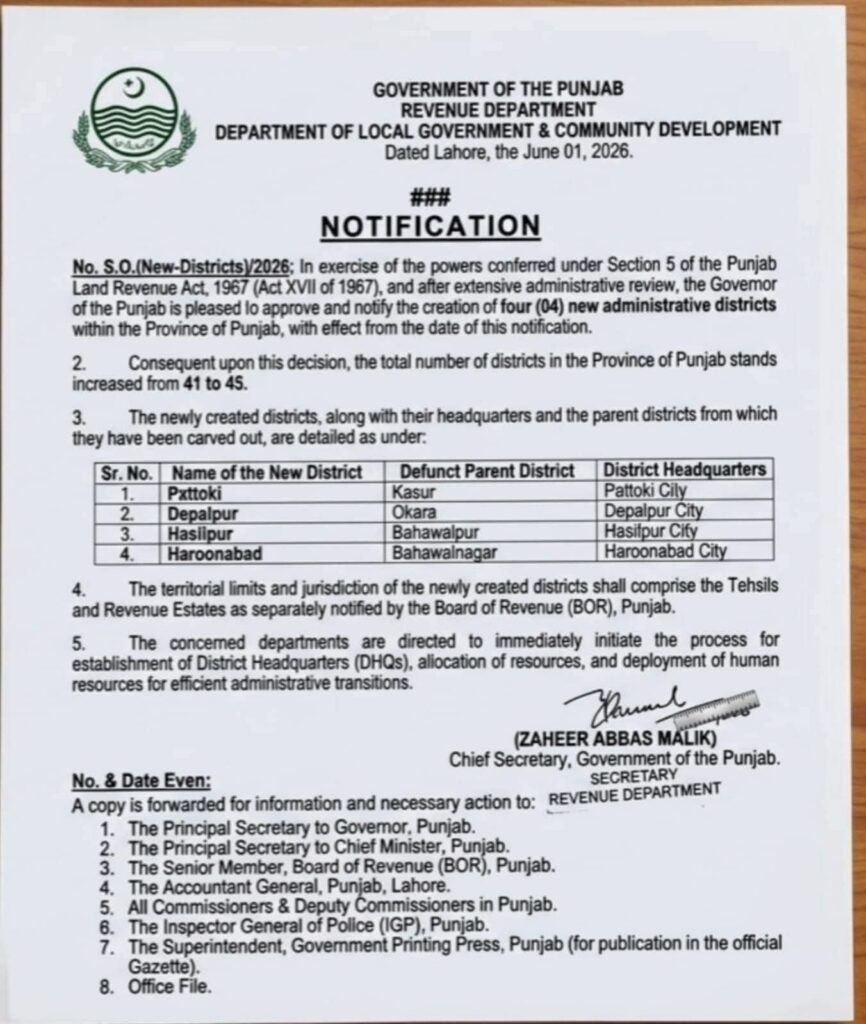
Something big just happened in Punjab’s administrative history — and honestly, when I first saw this notification circulating in WhatsApp groups this morning, I thought it was one of those rumours that pop up every few months. But no, this one is real. The Government of Punjab has officially approved the creation of four new administrative districts, effective today, June 1, 2026.
I’ve been following Punjab’s administrative restructuring debates for a few years now. People in areas like Pattoki, Depalpur, Hasilpur, and Haroonabad have been demanding separate district status for a long time — and today, that finally became official reality.
Let me break down everything in this notification clearly, because there’s a lot to understand beyond just the names.
What Exactly Happened? The Official Notification
The Punjab Revenue Department and the Department of Local Government & Community Development issued a formal notification on June 1, 2026 (No. S.O.(New-Districts)/2026) under Section 5 of the Punjab Land Revenue Act, 1967 (Act XVII of 1967).
The Governor of Punjab, after an extensive administrative review, approved the creation of four new districts within the province. These districts are effective immediately from the date of the notification.
The most significant consequence: Punjab’s total district count has increased from 41 to 45.
That’s not a small change. More districts mean more localized governance, more District Headquarters (DHQs), more administrative staff, and ultimately — better access to government services for millions of residents who previously had to travel long distances to their parent district headquarters.
The 4 New Districts of Punjab 2026 — Complete Details
Here is the exact data from the official notification:
Sr. No. | Name of New District | Parent (Defunct) District | District Headquarters
1 | Pattoki | Kasur | Pattoki City
2 | Depalpur | Okara | Depalpur City
3 | Hasilpur | Bahawalpur | Hasilpur City
4 | Haroonabad | Bahawalnagar | Haroonabad City
Each of these new districts has been carved out from its parent district. The territorial limits and jurisdiction of these new districts will comprise the Tehsils and Revenue Estates as separately notified by the Board of Revenue (BOR), Punjab.
Why Does This Matter? A Ground-Level Perspective
I’ll be honest — when you live in a large district like Bahawalpur or Kasur, getting simple government work done can be a nightmare. Court matters, revenue records, NADRA-related issues, police matters — everything routes through the district headquarters. If you’re sitting in Hasilpur and your DHQ is in Bahawalpur, that’s a journey. A full day’s journey, often.
This restructuring is meant to fix exactly that problem.
When Hasilpur becomes its own district with its own DHQ, residents no longer need to deal with Bahawalpur for every administrative task. Police stations will have a closer chain of command. Revenue courts will be more accessible. It’s a practical change that will be felt at the tehsil and village level.
The same logic applies to Pattoki (previously under Kasur), Depalpur (previously under Okara), and Haroonabad (previously under Bahawalnagar). These are areas with substantial populations and economic activity that were, frankly, underserved by distant district administrations.
What Happens Next — The Administrative Transition
Clause 5 of the notification makes it clear: concerned departments are directed to immediately initiate:
- Establishment of District Headquarters (DHQs)
- Allocation of resources to the new districts
- Deployment of human resources for efficient administrative transitions
This means the process of setting up full district machinery — Deputy Commissioners’ offices, Sessions Courts, Police headquarters, Revenue offices, DHQ hospitals, and more — is now officially underway.
In past experiences with district restructuring in Pakistan (when districts like Nankana Sahib were carved out of Sheikhupura, for instance), the full functional transition typically takes 6 to 18 months. Staff get transferred, offices get established, and gradually the new district starts operating independently.
Residents of these four new districts should start monitoring their local revenue and police offices for updates on when district-level services will become available locally.
The Signing Authority and Legal Backing
This notification was signed by Zaheer Abbas Malik, Chief Secretary, Government of the Punjab, in his capacity as Secretary of the Revenue Department. It carries the force of law under the Punjab Land Revenue Act, 1967.
Copies were forwarded to:
- The Principal Secretary to the Governor, Punjab
- The Principal Secretary to the Chief Minister, Punjab
- The Senior Member, Board of Revenue (BOR), Punjab
- The Accountant General, Punjab, Lahore
- All Commissioners and Deputy Commissioners in Punjab
- The Inspector General of Police (IGP), Punjab
- The Superintendent, Government Printing Press, Punjab (for publication in the Official Gazette)
- Office File
The mention of the Official Gazette is important. Once published there, this notification becomes the permanent legal record. For any legal proceedings, land record matters, or jurisdictional questions going forward, the Gazette publication date is the reference point.
Historical Context: Punjab’s Expanding District Map
Punjab originally had fewer districts. The number has grown over decades as population increased and administrative needs evolved. Here’s a quick look at key milestones:
- 1990s: Districts were reorganized significantly; the number stood around 34.
- 2000 (Local Government Ordinance, Musharraf era): Districts were restructured and Tehsil Municipal Administrations (TMAs) were introduced.
- Post-2008: The province reverted to older administrative structures; district count settled around 36, then grew further.
- Recent years (up to 2025): Punjab had 41 districts.
- June 1, 2026: Punjab now has 45 districts.
This growth reflects both population pressure and the demand for closer, more responsive local governance — something the government of Punjab has been under pressure to deliver for years.
For a deeper understanding of Pakistan’s administrative structure and governance framework, the Government of Pakistan’s official portal (https://www.pakistan.gov.pk) provides comprehensive departmental information.
Impact on Residents: What You Should Know
If you live in Pattoki, Depalpur, Hasilpur, or Haroonabad, here’s what this practically means for you:
Revenue and Land Records
- Your revenue matters will now be handled locally at the new district level, not at the parent district.
- Land records, mutations, fard, and related documents will gradually be transferred to local authority.
- Contact your local Patwari or Tehsildar for updates on the transition timeline.
Police and Law Enforcement
- The IGP Punjab has been notified. Local police stations will begin reporting to the new district police structures.
- SSP (Senior Superintendent of Police) offices will be established in each new district headquarters.
Education and Health
- New district-level education and health authorities will be established.
- This means easier access to District Education Officers (DEOs) and District Health Officers (DHOs) for both the public and government employees.
- Teachers and health workers in these areas may see changes in their posting and service record management.
Courts and Legal Matters
- Sessions and civil courts at the district level will be established.
- Pending cases from the parent districts may be transferred based on territorial jurisdiction.
- Consult a lawyer if you have active court matters to understand how jurisdiction changes may affect your case.
For ongoing updates on Punjab’s administrative changes and government notifications, you can also follow Education47 (https://education47.com) — the site regularly covers official Punjab government announcements, job notifications, and policy changes.
Common Questions People Are Getting Wrong
I’ve already seen some confusion spreading on social media, so let me address a few things:
“Does this mean my CNIC will change?”
No. Your CNIC is based on your birth registration location and does not automatically change with administrative restructuring. You do not need to update your CNIC just because your district has changed. However, if your CNIC shows the parent district and you want it updated, you can visit NADRA after the official transition is complete.
“Will property prices change?”
Administrative restructuring alone does not directly change property values. However, historically, areas that get district status tend to see increased investment and infrastructure development over time, which can positively affect property values in the medium to long term.
“Will government jobs in these areas be re-advertised?”
New district-level positions — like DCO staff, district police officers, and district health/education staff — will be advertised as the administrative machinery is established. Existing staff from parent districts may be transferred. Watch official job portals and Education47 for recruitment announcements.
Mistakes to Avoid Right Now
If you’re a resident or a professional dealing with matters in these new districts:
- Do not assume all services have immediately shifted. The notification is effective today, but the physical infrastructure takes time.
- Do not submit revenue documents to the new district office until you confirm it is operational. For now, continue dealing with your existing parent district office unless directed otherwise.
- Do not rely on social media for specific dates of service transfers. Only official Board of Revenue and provincial government announcements should be trusted.
- Do not ignore Gazette notifications — once published, they define legal jurisdiction for your area.
Reaction and Significance
Residents of these areas have long felt neglected within their large parent districts. The demand for Pattoki district, for instance, has been a local political issue for over a decade. Depalpur’s separation from Okara has similarly been discussed by local leaders for years.
The fact that this has been executed under the Punjab Land Revenue Act, 1967 — with a direct mandate from the Governor — gives it strong legal grounding. This isn’t an administrative experiment; it is a permanent restructuring backed by provincial law.
For comparative reference, the process of how districts are constituted and governed in Pakistan is well-documented by the Local Government Commission of Punjab (https://lgkpp.punjab.gov.pk), which provides frameworks for understanding governance at the district level.
Additionally, the Board of Revenue Punjab (https://bor.punjab.gov.pk) will be the key authority managing land record and revenue transitions for these new districts. Bookmark that site if you’re dealing with property or revenue matters in Pattoki, Depalpur, Hasilpur, or Haroonabad.
New Districts at a Glance — Quick Reference Table
Detail | Information
Notification Number | No. S.O.(New-Districts)/2026
Date of Issue | June 1, 2026
Issuing Authority | Revenue Dept. & Local Govt. Dept., Punjab
Legal Authority | Section 5, Punjab Land Revenue Act, 1967 (Act XVII of 1967)
Number of New Districts | 4
Previous Total Districts | 41
New Total Districts | 45
Signed By | Zaheer Abbas Malik, Chief Secretary Punjab
New District 1 | Pattoki (from Kasur)
New District 2 | Depalpur (from Okara)
New District 3 | Hasilpur (from Bahawalpur)
New District 4 | Haroonabad (from Bahawalnagar)
FAQs — Punjab New Districts 2026
Q1: How many new districts have been created in Punjab in 2026?
Four new districts — Pattoki, Depalpur, Hasilpur, and Haroonabad — have been officially created as of June 1, 2026.
Q2: What is the new total number of districts in Punjab?
Punjab now has 45 districts, increased from the previous 41.
Q3: Which district was Pattoki part of before?
Pattoki was part of Kasur district. It is now a separate district with its headquarters at Pattoki City.
Q4: Which district was Depalpur carved out of?
Depalpur has been separated from Okara district. Its district headquarters is Depalpur City.
Q5: What is the parent district of Hasilpur?
Hasilpur was part of Bahawalpur district and is now an independent district with its headquarters at Hasilpur City.
Q6: Where does Haroonabad come from?
Haroonabad was carved out of Bahawalnagar district. Its headquarters is Haroonabad City.
Q7: Under which law were these new districts created?
The districts were created under Section 5 of the Punjab Land Revenue Act, 1967 (Act XVII of 1967).
Q8: Who signed the official notification?
The notification was signed by Zaheer Abbas Malik, Chief Secretary, Government of the Punjab, in his capacity as Secretary, Revenue Department.
Q9: When will the new district offices become fully functional?
The notification directs departments to immediately begin establishing District Headquarters. Full functionality typically takes several months. Follow official Punjab government announcements for specific dates.
Q10: Will existing court cases be transferred to the new district courts?
Jurisdictional transfers for court matters will depend on Board of Revenue and judiciary notifications. Consult your lawyer for case-specific guidance.
Final Thoughts
This is genuinely significant news for millions of people across southern and central Punjab. Four new districts means four new centers of administrative power — closer to the people who need them most.
The communities of Pattoki, Depalpur, Hasilpur, and Haroonabad have waited a long time for this. The official wheels are now in motion. What matters next is the speed and quality of implementation — whether DHQs are established quickly, whether staff are deployed efficiently, and whether residents actually feel the change.
We’ll keep tracking official announcements as this transition unfolds.
For more updates on Punjab government notifications, education news, and government job announcements, stay connected with Education47 (https://education47.com) — your trusted source for Pakistan’s latest official news.
References & Official Sources:
- Government of Punjab Official Notification No. S.O.(New-Districts)/2026, dated June 1, 2026
- Punjab Land Revenue Act, 1967 (Act XVII of 1967)
- Board of Revenue Punjab: https://bor.punjab.gov.pk
- Local Government Commission Punjab: https://lgkpp.punjab.gov.pk
- Government of Pakistan Official Portal: https://www.pakistan.gov.pk
Tags: Punjab New Districts 2026, Pattoki District, Depalpur District, Hasilpur District, Haroonabad District, Punjab Administrative Restructuring, Punjab Revenue Department, Government of Punjab Notification
پنجاب کے چار نئیے ڈسٹرکٹ بنادئیے گئے۔پتوکی,دیپالپور,حاصلپور,ہارون آباد