PLRA-FBR Integrated Sale Registry System in Punjab May 2026
PLRA-FBR Integrated Sale Registry System in Punjab: Everything You Need to Know in 2026
My cousin sold a small plot in Gujranwala last year. Before this new system was rolled out, he had to run between the FBR office, the Sub-Registrar, the bank for challan, and then back to PLRA — all in separate visits over multiple days. He told me he spent almost a week just on paperwork. The agents took their cut. The process was opaque, confusing, and honestly, stressful.
Then, a few months later, when he helped a friend register a property sale under Punjab’s new PLRA-FBR integrated system, the same process took a fraction of the time. Everything was tracked digitally. The FBR challan was auto-generated. The tax figures were calculated by the system itself. No one could manipulate the numbers.
That’s the kind of change the Punjab Government’s PLRA-FBR linked sale registry system is bringing to the table — and if you are buying or selling property in Punjab right now, you absolutely need to understand how this works.
What Is the PLRA-FBR Integrated System?
The Punjab Land Records Authority (PLRA) manages all land ownership records across Punjab. The Federal Board of Revenue (FBR) handles federal taxation on property transactions — specifically through Section 236-C (tax on sellers) and Section 236-K (tax on buyers).
For years, these two systems operated independently. A seller would generate an e-stamp challan through PLRA, then separately visit FBR to handle withholding tax, and then head to the Sub-Registrar for physical registration. There was massive room for manipulation, data mismatch, and revenue leakage.
Under a landmark pilot project initially focused on Multan, FBR and PLRA officials reviewed the integration of e-stamp paper with FBR data systems, with the specific goal of plugging revenue leakage through digital means. UrduPoint It was decided that all provincial and federal taxes related to property transfers would be collected at the time of registration through the e-stamp paper — including FBR taxes — through the same unified system. UrduPoint
This is the core idea: one transaction, one integrated system, zero manual interference.
The 7-Step Process Explained Simply
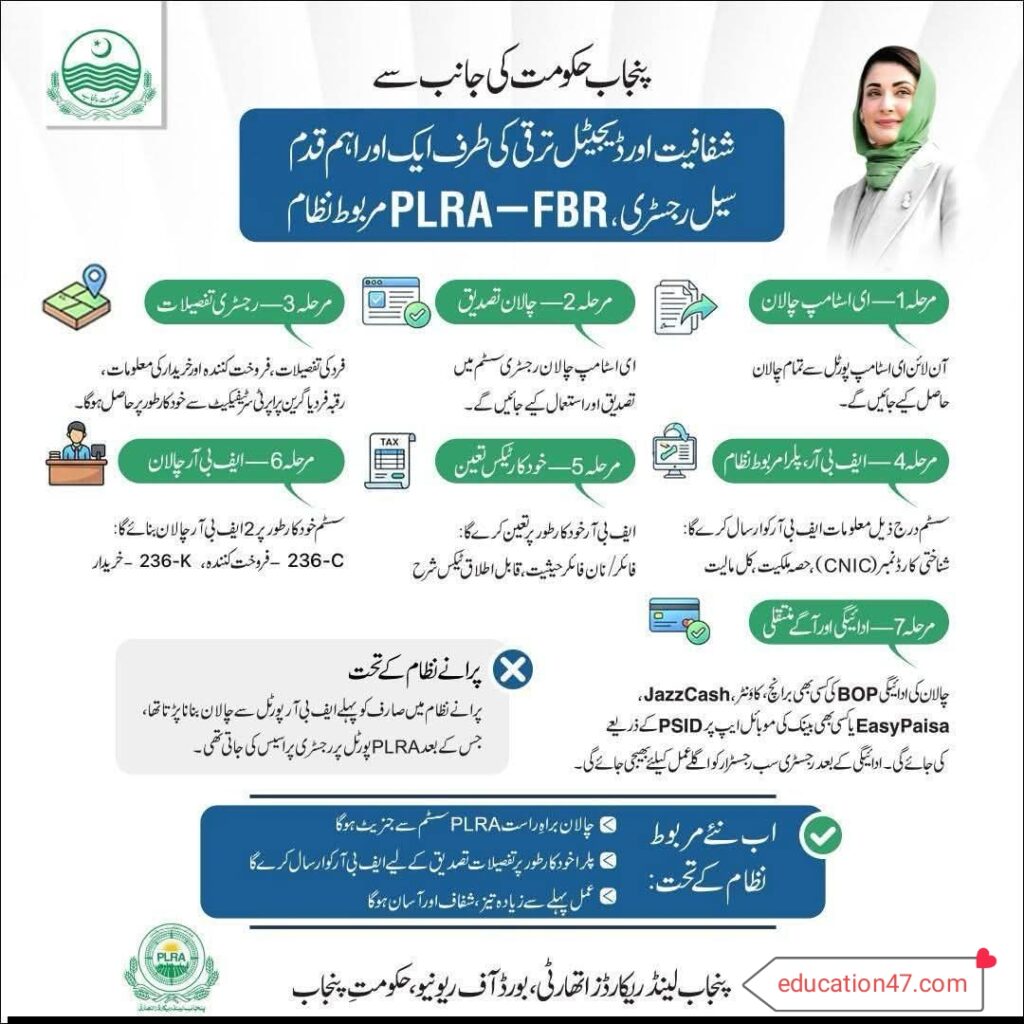
The infographic released by the Punjab Government and Board of Revenue outlines the entire sale registration journey under the new PLRA-FBR system. Here is a detailed breakdown:
Step 1: E-Stamp Challan
The entire process begins online. The buyer or seller (or their representative) visits the PLRA e-stamping portal at punjab-zameen.gov.pk and generates all required challans from a single portal. PLRA now offers a fully digital e-stamping service that citizens can access online at any time, eliminating the need for physical visits to banks or dealing with traditional paperwork. 8171passgov In just 10 days following one major update, more than 91,000 citizens used this e-stamping service — reflecting fast public adoption and growing trust in digital solutions. 8171passgov
Step 2: Challan Verification
Once the e-stamp challan is generated, it goes into the PLRA registry system for confirmation and validation. The system cross-checks the challan details, the property information, and the parties involved before proceeding. This verification step prevents fake documents from entering the pipeline.
Step 3: Registry Details
Both parties’ individual information — seller details, buyer details, property information — are captured and verified through biometric Green Card identity tracking. This step ensures that the person sitting across the table is actually who they claim to be, significantly reducing property fraud.
Step 4: FBR Linked System
This is where the integration gets powerful. The PLRA system collaborates with multiple government departments to ensure accuracy and interconnected data. Welcome To Punjab In the new model, PLRA automatically sends key details to FBR — including the seller’s and buyer’s CNIC number, property ownership details, and total financial value of the transaction. FBR receives this automatically rather than relying on the applicant to show up separately.
Step 5: FBR Auto Tax Assignment
FBR’s system then automatically calculates the applicable withholding tax for both parties. Under the FY 2025-26 framework, Section 236-K applies to buyers at rates ranging from 1.5% for active filers up to 18.5% for non-filers on properties above PKR 100 million, while Section 236-C for sellers ranges from 4.5% for filers up to 11.5% for non-filers. TaxToday Pakistan The system assigns the applicable rate automatically based on whether the person is an active filer, late filer, or non-filer — without any human input that could be manipulated.
Step 6: FBR Challans
The system then auto-generates two FBR challans. One is under Section 236-C for the seller, and the other is under Section 236-K for the buyer. Previously, this required a separate manual visit to FBR. Now it is generated in the same pipeline — saving time, reducing errors, and removing the opportunity for anyone to underreport the transaction value.
Step 7: Payment and Transfer
Payment is made through multiple digital channels. Challans can be paid through BOP (Bank of Punjab) branches, counters, JazzCash, EasyPaisa, or any mobile banking app using PSID on the FBR IRIS portal. UrduPoint Once payment is confirmed, the registry is completed and all records are updated simultaneously in both the PLRA and FBR systems. The entire chain is completed and forwarded for mutation (intiqal) automatically.
What Was Wrong With the Old System?
It is important to understand why this change was necessary. Under the old process, a seller or buyer would first create challans using FBR’s portal separately. Those challans would then be presented at the PLRA portal for the registry process. After PLRA’s part was done, the registration price would be applied through a separate PLRA portal entry. The two systems talked to each other only loosely, leaving gaps for data manipulation, undervaluation of properties, and outright corruption.
Commissioner Multan Amir Kareem Khan confirmed that once fully implemented, this integrated system will help eliminate corruption worth billions of rupees in tax collection. UrduPoint The key word here is “billions” — and that tells you how broken the old system was.
What Does This Mean for You as a Buyer or Seller?
Here is the practical reality if you are planning a property transaction in Punjab right now:
Your filer status matters more than ever. Buyers registered as active taxpayers under FBR pay almost five to six times less tax than non-filers under the current framework. Dharealestate Make sure you are on the Active Taxpayer List (ATL) before your property transaction date.
The system calculates your taxes automatically. You cannot negotiate rates at the Sub-Registrar’s office anymore. The FBR-assigned tax is final and generated by an algorithm based on your CNIC and property value.
CNIC verification is now biometric. Fake or proxy registrations are much harder to execute. Your identity is tied to the Nadra database and verified through the Green Card system.
Payment is fully digital. You do not need to carry physical cash to any government office. Use JazzCash, EasyPaisa, mobile banking, or visit a Bank of Punjab branch with your PSID number.
Benefits of the New System
- Transparency: Every step is logged digitally, with no room for undercounting or underdisclosure
- Speed: What used to take multiple days and multiple visits can now be completed far more efficiently
- Reduced corruption: Since tax values are auto-assigned, there is no room for under-the-table rate negotiation
- Tax compliance enforcement: Your filer/non-filer status directly determines your tax rate — automatically
- Remote accessibility: Overseas Pakistanis can now track and authorize property transactions digitally without being present in Pakistan
- Simultaneous record update: PLRA and FBR records update together, reducing mismatches and disputes later
Tax Rates at a Glance: FY 2025-26
| Tax Type | Who Pays | Filer Rate | Non-Filer Rate |
|---|---|---|---|
| Section 236-K | Buyer | 1.5% (up to PKR 50M) | Up to 18.5% |
| Section 236-C | Seller | 4.5% (up to PKR 50M) | Up to 11.5% |
| Stamp Duty | Buyer | 1% of property value | 1% of property value |
| CVT | Buyer | 2% of property value | 2% of property value |
| PLRA Charges | Both | PKR 3,300 (approx.) | PKR 3,300 (approx.) |
Note: Rates apply on FBR-notified valuations. Always verify current rates directly on the FBR website (fbr.gov.pk) before completing any transaction.
Common Mistakes People Are Still Making
Not becoming a filer before the transaction. This is the single biggest financial mistake you can make. A non-filer buyer pays dramatically more in 236-K tax compared to a filer. Filing your income tax return costs almost nothing but saves you tens of thousands, or even lakhs, on a single property deal.
Relying on agents for tax calculations. Agents often quote incorrect figures — either inflated to show value in their service, or deflated to make a deal look attractive. Use the official FBR property tax calculator directly.
Assuming the old process still works. Some people are still going to offices expecting to handle FBR and PLRA separately. The integration of the e-stamp system with FBR data has been formally initiated and is being actively rolled out across Punjab starting from Multan as the pilot city. UrduPoint Check current status before your visit.
Not verifying property ownership through PLRA first. Before any transaction, run the property through PLRA’s online portal to check for any disputes, liens, or ownership complications. Through the Punjab digital property registration system, property owners or buyers can access the PLRA online portal and enter the property reference number or CNIC to retrieve ownership details. Arzaaypak
How to Apply / Get Started Online
For property registration and e-stamp services, visit the official PLRA portal directly:
[Apply / Register Online at Punjab Zameen — punjab-zameen.gov.pk]
For FBR tax challan generation, PSID creation, and tax compliance verification, visit the official FBR portal:
[FBR IRIS Portal — iris.fbr.gov.pk]
You can also verify your ATL (Active Taxpayer List) status at:
[ATL Check — fbr.gov.pk/ams/irisnew/rlang=en]
For more guides on property registration, education schemes, and government digital services in Pakistan, visit education47.com — a trusted resource covering the latest government programs and how to access them.
FAQs
Q: What is the PLRA-FBR integrated system?
A: It is a digital linkage between Punjab Land Records Authority (PLRA) and the Federal Board of Revenue (FBR) that combines property registry and tax challan generation into one streamlined, automated pipeline.
Q: Do I need to visit multiple offices for property registration now?
A: The new system significantly reduces the need for multiple visits. E-stamp challans, FBR tax assignment, and registry details are now handled in an integrated online workflow. Physical presence may still be required at the Sub-Registrar for final signing and biometric verification.
Q: How does filer status affect my property tax?
A: Filers pay significantly less in advance taxes under Sections 236C and 236K compared to non-filers — the gap can be enormous, making it financially critical to become an active filer before any property transaction. ICONS
Q: Can I pay property tax through JazzCash or EasyPaisa?
A: Yes. Challans generated with a PSID number can be paid through JazzCash, EasyPaisa, Bank of Punjab branches, or any mobile banking app that supports FBR payments.
Q: Can overseas Pakistanis use this system?
A: The digital system allows overseas Pakistanis to authorize property transactions securely and monitor land records remotely, and is expected to boost overseas investment in Punjab’s real estate sector. Pave.pk
Q: What is Section 236-C?
A: Section 236-C is an FBR advance tax paid by the seller at the time of property transfer, with rates ranging from 4.5% for active filers to 11.5% for non-filers. TaxToday Pakistan
Q: What is Section 236-K?
A: Section 236-K is an FBR advance tax paid by the buyer at the time of property transfer, with rates ranging from 1.5% for active filers on properties up to PKR 50 million, going up to 18.5% for non-filers on higher-value properties. TaxToday Pakistan
Q: Where can I check my property ownership records online?
A: Visit the official PLRA portal at punjab-zameen.gov.pk and enter your CNIC or property reference number.
Conclusion
The PLRA-FBR integrated sale registry system is not just a technical upgrade — it is a cultural shift in how property transactions are handled in Punjab. For decades, the real estate sector in Pakistan was seen as opaque, heavily agent-driven, and prone to manipulation. This system directly attacks those problems by making tax assignment automatic, record-keeping simultaneous, and the entire process digital.
If you are planning to buy or sell property in Punjab, now is the time to get your tax affairs in order. Become an active FBR filer, understand your applicable tax slabs, use the official portals, and do not rely on unofficial agents for compliance advice.
The system is improving, and the people who adapt early will benefit the most.
For more government scheme updates, digital services guides, and education-related news from Pakistan, keep visiting education47.com.
References and Authority Sources:
- Punjab Land Records Authority Official Portal: punjab-zameen.gov.pk
- Federal Board of Revenue (FBR): fbr.gov.pk
- Associated Press of Pakistan (APP) — PLRA-FBR Integration Report, March 2026: app.com.pk