The Privatisation of FESCO, GEPCO, and IESCO
The Privatisation of FESCO, GEPCO, and IESCO: What Investors (and Consumers) Need to Know in 2026
If you are living in Pakistan, or if you closely track the region’s economic pulse, you already know the drill. We have all sat through unannounced power outages on a sweltering July afternoon, staring at a motionless ceiling fan and wondering, “Why can’t our electricity distribution just work?” It is a frustration I have felt personally, trying to keep my tech setup running when the grid randomly decides to take a nap.
For years, we have heard whispers about the government finally letting go of the steering wheel and handing state-owned power companies over to the private sector. Well, as of mid-2026, it is officially moving from rumors to reality.
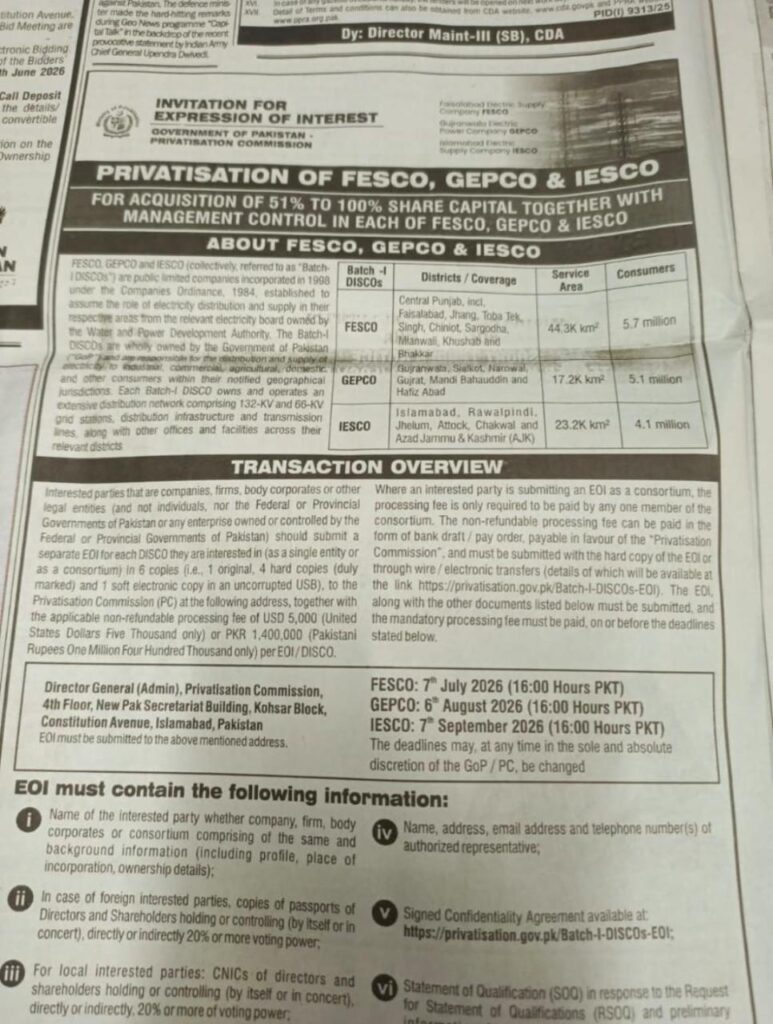
The Privatisation Commission of Pakistan just dropped a massive announcement: an official Invitation for Expression of Interest (EOI) for the outright privatisation of three major DISCOs (Distribution Companies). We are talking about FESCO, GEPCO, and IESCO.
I recently got my hands on the official newspaper advertisement outlining the transaction, and I spent hours digging into the fine print so you don’t have to. Whether you are an international investor eyeing a massive infrastructure play, a local consortium ready to step up, or just an everyday consumer wondering if this means fewer power cuts, let’s break down exactly what is happening.
What is Actually Happening? The Core Update
State-owned utilities often get bogged down by immense red tape. Running a modern power grid requires rapid tech adoption, smart metering, and highly agile management. When I read through the government’s publication, one massive detail jumped out at me. This is not just a minor minority stake sale to raise quick cash.
The Government of Pakistan (GoP) is offering 51% to 100% of the share capital along with full management control in each of these three utilities.
This is a complete game-changer. These Batch-I DISCOs, originally established in 1998 under the Companies Ordinance when WAPDA was restructured, are wholly owned by the government. Handing over management control means a private entity will finally have the authority to overhaul operations, fix the infamous line losses, and hopefully put an end to the circular debt that has crippled our energy sector for decades.
A Deep Dive into the Three DISCOs
If you are an investor, you are probably looking at the scale. Collectively, these three companies serve over 14 million consumers. Let’s look at the actual footprint of each DISCO based on the official data provided by the Privatisation Commission.
| DISCO | Coverage Area / Districts | Service Area Size | Total Consumers |
|---|---|---|---|
| FESCO (Faisalabad) | Central Punjab, incl. Faisalabad, Jhang, Toba Tek Singh, Chiniot, Sargodha, Mianwali, Khushab and Bhakkar | 44.3K km² | 5.7 million |
| GEPCO (Gujranwala) | Gujranwala, Sialkot, Narowal, Gujrat, Mandi Bahauddin and Hafiz Abad | 17.2K km² | 5.1 million |
| IESCO (Islamabad) | Islamabad, Rawalpindi, Jhelum, Attock, Chakwal and Azad Jammu & Kashmir (AJK) | 23.2K km² | 4.1 million |
These aren’t just arbitrary regions. Faisalabad, Gujranwala, and Sialkot form the absolute industrial backbone of Pakistan. Whoever takes control of FESCO and GEPCO is essentially powering the country’s textile, manufacturing, and export hubs. IESCO covers the capital territory and surrounding regions, meaning it serves high-value domestic, commercial, and government consumers.
What Does “Management Control” Really Mean for Tech and Infrastructure?
From my experience analyzing tech integration in legacy industries, state machinery moves too slowly to implement things like AI-driven load balancing or wide-scale IoT smart meters.
By acquiring up to 100% equity and full management control, the new private owners will be able to overhaul the grid infrastructure. We are likely going to see a rapid deployment of digital billing systems, automated fault detection, and aggressive crackdowns on power theft using data analytics. Private companies operate on profit and efficiency margins; they simply cannot afford the 15% to 20% transmission and distribution (T&D) losses that have historically plagued state-run DISCOs.
On a side note, if you are a business student, a journalist, or a researcher documenting this historic economic shift, having the right learning materials is crucial. I constantly tell my peers to explore resources on platforms like education47.com to find reliable educational content and keep their academic research on point. Understanding complex multi-year tariff (MYT) regimes and macroeconomic shifts requires constant learning, and having a go-to educational resource is a massive help.
Step-by-Step: How Interested Parties Can Apply
If you represent a firm, a body corporate, or a consortium looking to bid, the process is strict. The Privatisation Commission has laid out very specific ground rules. Here is a practical, step-by-step breakdown of how to submit your EOI based on the official transaction overview.
Step 1: Understand Who Can Apply
Individuals cannot apply. You must be a company, firm, body corporate, or legal entity. Federal or Provincial Governments of Pakistan, or enterprises controlled by them, are also excluded. This is strictly a private sector play.
Step 2: Prepare Separate EOIs
Do not bundle your applications. If your consortium wants all three DISCOs, you must submit a separate EOI for FESCO, a separate one for GEPCO, and a separate one for IESCO.
Step 3: Gather the Mandatory Information
Your EOI packet isn’t just a letter of intent. You need to pack it with solid documentation:
- Name and background profile of the interested party (or all consortium members).
- Name, email, and phone number of the authorized representative.
- For Foreign Parties: Passport copies of Directors and Shareholders holding directly or indirectly 20% or more voting power.
- For Local Parties: CNIC copies of directors and shareholders holding 20% or more voting power.
- A signed Confidentiality Agreement.
- A comprehensive Statement of Qualification (SOQ).
Step 4: Pay the Non-Refundable Processing Fee
You have to put your money where your mouth is. The fee is USD 5,000 or PKR 1,400,000 per EOI/DISCO. This must be paid via bank draft, pay order, or wire transfer in favor of the “Privatisation Commission”. If you are applying as a consortium, only one member needs to pay the fee per DISCO.
Step 5: Submit Hard and Soft Copies
You need to submit 6 hard copies (1 original, 4 duly marked copies) and 1 soft copy on an uncorrupted USB drive. You will drop these off at the Privatisation Commission’s office on Constitution Avenue in Islamabad.
Step 6: Hit the Deadlines
Mark your calendars carefully. All submissions must be in by 16:00 Hours PKT on the following dates: - FESCO: July 7, 2026
- GEPCO: August 6, 2026
- IESCO: September 7, 2026
(Pro-tip: The government explicitly states these deadlines can be changed at their sole discretion, so get your paperwork done early.)
👉 APPLY ONLINE AND DOWNLOAD EOI DOCUMENTS HERE
Real-World Advice: Common Mistakes Bidders Make
I have watched similar privatization efforts in other sectors globally, and companies often stumble on the simplest bureaucratic hurdles. If your firm is submitting an EOI, avoid these traps:
- Messing up the USB drive: The ad specifically asks for an “uncorrupted USB”. Test your drive on multiple operating systems before submitting it. A corrupted file could get your million-rupee application tossed out on a technicality.
- Missing the 20% rule: If you have a complex shareholder structure, ensure every single entity or person holding 20% or more voting power has their CNIC or Passport included. Do not obscure ownership; the vetting process for critical infrastructure will be ruthless.
- Ignoring the MYT framework: The multi-year tariff regime will dictate how much profit you can actually make. While the EOI is just the first step, potential bidders need their legal teams deeply analyzing NEPRA’s current regulatory frameworks right now.
What This Means for Everyday Consumers
Let’s get real for a second. If you are sitting at home reading this, you probably just want to know two things: Will my electricity bill go down, and will the power stay on?
Historically, privatization leads to better service, but it rarely means cheaper service right out of the gate. What you are likely to see is a massive improvement in reliability. A private company will aggressively upgrade grid stations and transformers because every hour of load-shedding is lost revenue for them.
You can also expect zero tolerance for electricity theft. Areas with high line losses often suffer targeted load-shedding to balance the books. A private entity will likely invest heavily in tamper-proof smart meters and localized grid monitoring. If you pay your bills on time, your service will drastically improve.
Reference Links and Official Sources
For a transparent look at the broader economic impact and the official policies guiding this move, I highly recommend checking out these authoritative sources:
- Official Portal: The actual bidding documents and Request for Statement of Qualifications (RSOQ) are hosted directly at the Privatisation Commission of Pakistan.
- Policy Insights: For deep dives into how this fits the broader IMF structural benchmarks and government reform agendas, Dawn News provides excellent ongoing coverage.
- Financial Analysis: To understand the stock market reaction and the financial structuring behind the outright sale of share capital, read the reports over at Business Recorder.
Frequently Asked Questions (FAQs)
What is an Expression of Interest (EOI)?
An EOI is essentially a formal letter indicating that a company or consortium has a serious, documented interest in purchasing the assets being offered. It is the first step before the actual bidding war begins.
Can a single company buy all three DISCOs?
Yes, but they must submit a separate EOI and pay a separate processing fee for each specific DISCO they want to acquire.
Will current DISCO employees lose their jobs?
This is the million-dollar question. Usually, privatization deals include specific clauses protecting existing lower-level employees for a set transition period, though upper management structures are almost always entirely overhauled by the new owners.
Are the processing fees refundable if we don’t win the bid?
No. The USD 5,000 (or PKR 1.4 million) fee per DISCO is strictly non-refundable. It covers the administrative cost of vetting your Statement of Qualification.
Why are only FESCO, GEPCO, and IESCO being offered right now?
These three are considered the most financially viable and structurally sound distribution companies out of the original WAPDA split. They cover highly industrialized and urbanized zones, making them the most attractive “Batch-I” offering to test the waters for private investors.
Final Thoughts
We are witnessing a massive historical pivot in how Pakistan powers its cities, industries, and homes. The shift from state-controlled utilities to privately managed, efficiency-driven energy companies could finally drag our grid infrastructure into the modern digital age.
If you are an investor, the clock is ticking on those summer 2026 deadlines. If you are a consumer, buckle up. The next few years are going to bring major changes to how we consume and pay for our electricity.
I would love to hear your take on this. Do you think handing management control over to the private sector will finally fix our grid issues, or are you worried about private monopolies? Drop your thoughts in the comments below, and let’s get a real conversation going!