HEC HAT 2026
HEC HAT 2026: Everything You Need to Know About the Higher Education Aptitude Test (General & Subject) for Fall Admissions
Published on Education47.com | Updated: May 2026
I still remember the panic of my MS admission year. Sitting in a university office, being told my test score from one institution wouldn’t be accepted at another — even though both were HEC-recognized. The whole system felt broken. Different universities, different tests, different standards. It was exhausting, and honestly, unfair to students who were genuinely talented but got lost in the administrative chaos.
So when I heard that HEC and the Education Testing Council (ETC) are now rolling out a unified, standardized aptitude test for MS/M.Phil and PhD admissions — the HAT (Higher Education Aptitude Test) — I felt something I hadn’t felt about Pakistan’s education system in a while: actual hope.
Let me break this down for you like I’m explaining it to a friend over chai.
What Exactly Is the HAT and Why Does It Matter?
The Higher Education Aptitude Test, commonly referred to as HAT, is not just another exam. It’s a national-level standardized test designed by the Education Testing Council (ETC) under HEC (Higher Education Commission of Pakistan) to create a level playing field for graduate-level admissions across the country.
There are two types:
- HAT-General — For students applying to MS or M.Phil programs
- HAT-Subject — For students applying to PhD programs
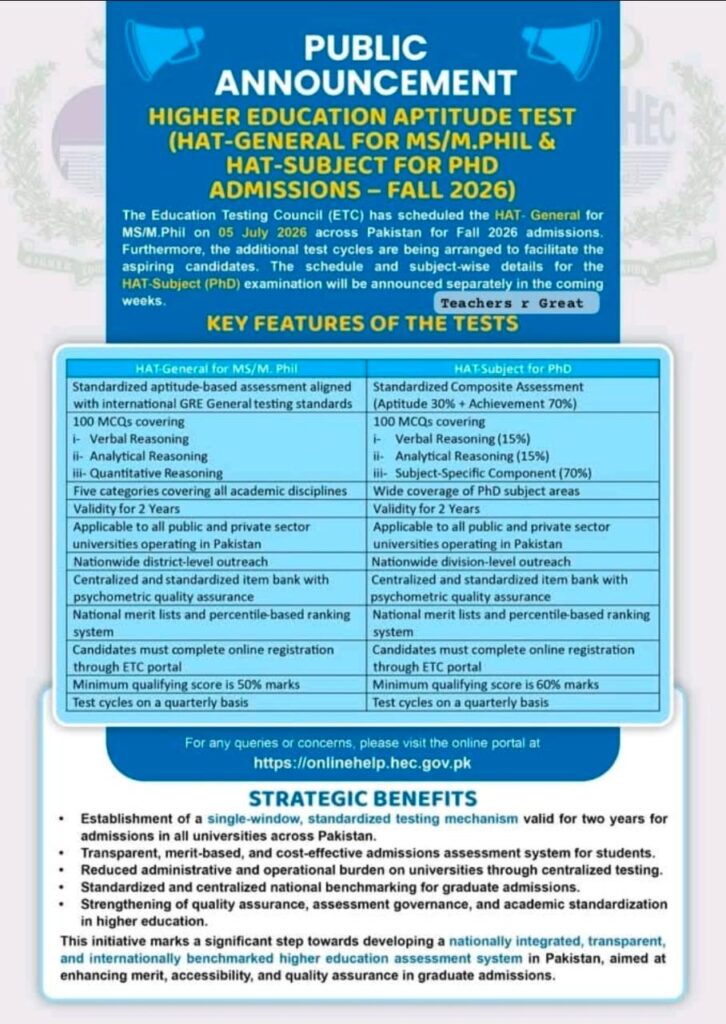
The HAT-General for MS/M.Phil is already confirmed and scheduled for 05 July 2026, and it will be held across Pakistan simultaneously. The HAT-Subject (PhD) schedule will be announced separately in the coming weeks — so keep your eyes on the official HEC portal.
This isn’t just a policy change on paper. It’s a structural shift in how Pakistan’s universities assess postgraduate applicants. And honestly, it’s long overdue.
Why HAT Is a Big Deal — From Someone Who’s Been Through the Old System
Here’s the thing nobody tells you when you’re applying for MS: each university used to have its own test. Some had easy entry tests. Some had notoriously difficult ones. Some had none at all. The result? The quality of admitted students varied wildly, and merit often took a back seat.
I’ve spoken to professors at two different universities in Lahore who’ve confirmed off the record that many departments struggled with inconsistent student quality. “We’d get brilliant students one semester, average ones the next — because the entry criteria kept changing,” one told me.
HAT fixes this. It creates a single benchmark.
Think of it like CSS for the civil service — one exam, one merit list, one standard. That’s essentially what HAT is becoming for MS and PhD admissions in Pakistan.
HAT-General for MS/M.Phil: What’s Inside the Test?
Let’s get into the specifics because this is where a lot of students get confused.
Format:
- 100 Multiple Choice Questions (MCQs)
- Three sections:
| Section | Topic |
|---|---|
| i | Verbal Reasoning |
| ii | Analytical Reasoning |
| iii | Quantitative Reasoning |
Other Key Details:
- Aligned with international GRE General testing standards (yes, if you’ve prepped for GRE, you’re already partially ready)
- Valid for 2 Years — so you don’t have to retake it every admission cycle
- Applicable at all public and private sector universities in Pakistan
- Nationwide district-level outreach — meaning test centers are spread across Pakistan, not just in big cities
- Registration and everything happens through the ETC portal
- Minimum qualifying score: 50%
- Test cycles run on a quarterly basis
- National merit lists and percentile-based ranking system
The GRE alignment is actually a smart move. It means the test is internationally benchmarked, which adds credibility to Pakistani MS degrees when students later apply abroad for PhDs or jobs.
HAT-Subject for PhD: A More Specialized Beast
If you’re going for a PhD, the HAT-Subject is different in structure — and more demanding, as it should be.
Format:
- 100 MCQs
- Composite Assessment structure:
| Component | Weightage |
|---|---|
| Aptitude (same as General) | 30% |
| Achievement (subject-specific) | 70% |
Breakdown of the Aptitude portion:
- Verbal Reasoning: 15%
- Analytical Reasoning: 15%
- Subject-Specific Component: 70%
Other Details:
- Wide coverage of PhD subject areas
- Valid for 2 Years
- Nationwide division-level outreach (broader than district-level for MS)
- Minimum qualifying score: 60% (higher bar than HAT-General)
- National merit lists and percentile-based ranking
The 70% subject-specific component is what makes this genuinely rigorous. It means you can’t just get by on general intelligence — you need actual domain knowledge in your field.
Side-by-Side Comparison: HAT-General vs HAT-Subject
| Feature | HAT-General (MS/M.Phil) | HAT-Subject (PhD) |
|---|---|---|
| MCQs | 100 | 100 |
| Structure | Purely aptitude-based | 30% Aptitude + 70% Achievement |
| Verbal Reasoning | Included | 15% |
| Analytical Reasoning | Included | 15% |
| Subject Component | Not included | 70% |
| GRE Alignment | Yes | Partially |
| Minimum Score | 50% | 60% |
| Validity | 2 Years | 2 Years |
| Outreach Level | District-level | Division-level |
| Test Cycle | Quarterly | Quarterly |
How to Register: Step-by-Step Guide
A lot of students I know panic when it comes to the registration part — they miss deadlines or fill forms incorrectly. Here’s what you need to do:
Step 1: Visit the ETC/HEC Portal
Go to the official HEC help portal at https://onlinehelp.hec.gov.pk for any queries or concerns.
Step 2: Create Your Account
If you don’t already have an HEC account, you’ll need to register with your CNIC, email, and basic academic information.
Step 3: Select Your Test Type
Choose either HAT-General (MS/M.Phil) or HAT-Subject (PhD). Make sure you’re selecting the right one — this is where people often make mistakes.
Step 4: Fill Your Application Form
Enter your academic details carefully. Your subject category for HAT-Subject must match your intended PhD discipline.
Step 5: Pay the Fee
Fee payment is done online. Keep the payment receipt — you’ll need it.
Step 6: Download Admit Card
Once confirmed, download your admit card well before the test date.
Step 7: Appear on Test Date
For HAT-General: 05 July 2026. For HAT-Subject: date to be announced.
Apply Online
If you’re ready to register, head to the official HEC portal right now:
Apply Online for HAT 2026 — Visit https://onlinehelp.hec.gov.pk
Don’t wait for the last minute. Registration portals in Pakistan tend to get overloaded close to deadlines — I’ve seen this happen with NTS, CSS, and other national exams. Apply early.
Strategic Benefits: Why This Is Good for Pakistani Higher Education
HEC isn’t just doing this for paperwork. There are real, structural benefits here:
- Single-window testing mechanism valid for two years — no more re-taking tests for every university you apply to
- Transparent, merit-based admissions — the national merit list and percentile ranking makes favoritism much harder
- Reduced administrative burden on universities — departments no longer have to design, conduct, and grade their own entry tests
- Standardized national benchmarking for graduate admissions across all institutions
- Strengthening quality assurance in higher education at a systemic level
This is the kind of reform that doesn’t make headlines but changes everything at the ground level. For a student in Turbat or Chitral who used to struggle to even access information about different university entry tests, this is genuinely life-changing.
Common Mistakes Students Make (And How to Avoid Them)
I’ve seen these happen too many times:
1. Confusing HAT-General with HAT-Subject
These are two completely different tests. If you’re applying for MS, you need HAT-General. PhD applicants need HAT-Subject. Applying for the wrong one wastes your time and money.
2. Not Preparing for Quantitative Reasoning
Many humanities students underestimate the Quant section. It’s there for a reason. Start practicing basic math, data interpretation, and logical reasoning at least 6–8 weeks before the test.
3. Ignoring the Subject-Specific Component (for PhD)
If you’re taking HAT-Subject, 70% of your score comes from your subject domain. That means you need to be genuinely current on your field — not just your thesis topic, but the broader discipline.
4. Waiting Too Long to Register
Pakistan’s digital infrastructure is improving, but online portals still crash during peak registration periods. Register early.
5. Assuming One Score Works Forever
Your HAT score is valid for 2 years — but only 2 years. If you don’t get admission in this cycle, you have time, but don’t let complacency set in.
How to Prepare: Practical Tips That Actually Work
Since HAT-General is aligned with GRE standards, here’s what I’d recommend:
For Verbal Reasoning:
- Use the Manhattan Prep GRE Verbal guide
- Practice reading comprehension from Dawn’s opinion pages and academic journals
- Build vocabulary through context, not rote memorization
For Analytical Reasoning:
- Practice logical reasoning puzzles daily
- The LSAT Logical Reasoning prep material is surprisingly useful here
- Khan Academy has free analytical reasoning resources
For Quantitative Reasoning:
- GRE Math prep books (Manhattan Prep or Magoosh)
- Focus on: ratios, percentages, basic algebra, data interpretation
- Solve at least 20 MCQs daily in the 4 weeks before the exam
For HAT-Subject (PhD applicants):
- Review the last 5 years of key publications in your field
- Study your undergraduate and master’s-level textbooks in the subject-specific component
- Talk to your thesis supervisor about likely topic areas
Recommended free tools:
- Khan Academy — for math and reasoning practice
- Magoosh GRE Blog — free prep resources aligned with HAT-General format
- Education47.com — for regular updates, test prep guides, and Pakistani education news: https://education47.com
What Pakistani Students Should Know About the GRE Alignment
This is worth dwelling on for a moment because it has long-term implications.
The fact that HAT-General is aligned with GRE General testing standards means:
- Students who score well on HAT are likely GRE-ready, which opens doors to foreign scholarships like Fulbright, Commonwealth, and DAAD
- It legitimizes Pakistani MS degrees in the eyes of international institutions
- It pushes universities to maintain higher teaching standards to ensure their students can actually pass the HAT
According to ETS (the organization behind GRE), the GRE General Test measures verbal reasoning, quantitative reasoning, and analytical writing — three skills that are genuinely predictive of graduate school success. You can learn more about the GRE’s design rationale at https://www.ets.org/gre.
What Experts and Researchers Say About Standardized Testing in Higher Ed
Standardized admissions testing, when done right, has been shown to reduce bias in admissions decisions. A 2022 report by the World Bank’s education research division highlighted that merit-based standardized testing in South Asian higher education contexts significantly improved equity in admissions when combined with regional outreach — which is exactly what HEC is doing with district and division-level test centers.
The OECD’s research on higher education quality also consistently shows that countries with centralized, standardized graduate admissions processes tend to produce more globally competitive postgraduate talent. You can explore their findings at https://www.oecd.org/education/.
These aren’t just theoretical points — they’re backed by data from countries that Pakistan should be learning from.
FAQs: Real Questions Real Students Are Asking
Q: Is HAT mandatory for all MS/M.Phil applicants in Pakistan?
A: Yes, for Fall 2026 admissions, HAT-General is being implemented as a standardized requirement. All public and private sector universities operating in Pakistan will be part of this system.
Q: Can I use my HAT score at multiple universities?
A: Yes. The score is valid for 2 years and can be used for admissions at all HEC-recognized universities. That’s one of the biggest advantages of this system.
Q: What if I score below 50% on HAT-General?
A: The minimum qualifying score is 50% for HAT-General. If you don’t meet this threshold, you won’t be eligible for MS/M.Phil admissions under this cycle. However, since tests run quarterly, you can retake it.
Q: Is there negative marking?
A: Official details on negative marking haven’t been publicly confirmed yet. Keep checking https://onlinehelp.hec.gov.pk for updates.
Q: When will HAT-Subject (PhD) dates be announced?
A: HEC has stated the schedule will be announced “in the coming weeks.” Check the official portal and follow HEC’s official social media channels for updates.
Q: Is the test conducted online or on paper?
A: Based on the announcement, registration is online through the ETC portal, but the test format (online/paper-based) will be confirmed through official channels.
Q: Where can I find test centers near me?
A: HEC is implementing district-level outreach for HAT-General and division-level for HAT-Subject, meaning centers will be spread across the country. Specific center allocations will come with your admit card.
Q: I’m currently enrolled in a 4-year BS program. Can I register?
A: You should be completing or have completed your undergraduate degree to be eligible for MS admissions. Check specific eligibility criteria on the ETC portal.
A Note to University Departments
If you’re a faculty member or department head reading this — HAT is not a threat to your academic autonomy. It’s a tool that helps you get better students. The national merit list and percentile system means you can still select from the top applicants in your subject area. What you’re losing is the administrative burden of running your own entry test. That’s a good trade.
Final Thoughts
Look, Pakistan’s higher education sector has been trying to reform for years. Some reforms stuck, many didn’t. But HAT feels different — it’s operationally specific, it’s got a date (05 July 2026 for HAT-General), it’s aligned with international standards, and it’s being rolled out across the entire country simultaneously.
For students, this is genuinely good news. One test, valid at every university, for two years. Clear merit lists. No more running between institutions with different test formats and fee structures.
For the system, it’s a foundation. Get this right, and Pakistan can build a genuinely competitive postgraduate education ecosystem.
If you want to stay updated on HAT prep resources, test date announcements, and admission guidance, bookmark Education47.com — I’ll be posting regular updates as the July 2026 date approaches.
And if you have specific questions about registration, eligibility, or test preparation, drop them in the comments or visit the official HEC help portal at https://onlinehelp.hec.gov.pk.
Good luck. Prepare smart. Merit will get you there.
References & Official Sources:
- HEC Official Help Portal: https://onlinehelp.hec.gov.pk
- ETS GRE Official Information: https://www.ets.org/gre
- World Bank Education Research: https://www.worldbank.org/en/topic/education
- OECD Education at a Glance: https://www.oecd.org/education/
- Khan Academy Free Test Prep: https://www.khanacademy.org
- Magoosh GRE Blog: https://magoosh.com/gre/
- Education47.com Pakistan Education News & Guides: https://education47.com