Practical Exams in Punjab 2026
Practical Exams in Punjab 2026: What Every Student, Parent, and Teacher Needs to Know Right Now
Let me be honest with you — when my younger cousin called me in a panic last week saying his practical notebook had been “rejected” at the examination center, I had no idea what he was talking about at first. It took a solid 20-minute phone call for both of us to figure out what had actually happened, and why the examiner wouldn’t accept his notebook.
Turns out, he had bought a pre-filled practical copy from a shop near his school. Completely unaware that this was now a serious issue. And he was not alone — dozens of students at his center were in the same boat that morning.
That experience pushed me to dig deep into this whole situation. So here’s everything I’ve found out, explained the way I wish someone had explained it to him before exam day.
What’s Actually Going On This Year?
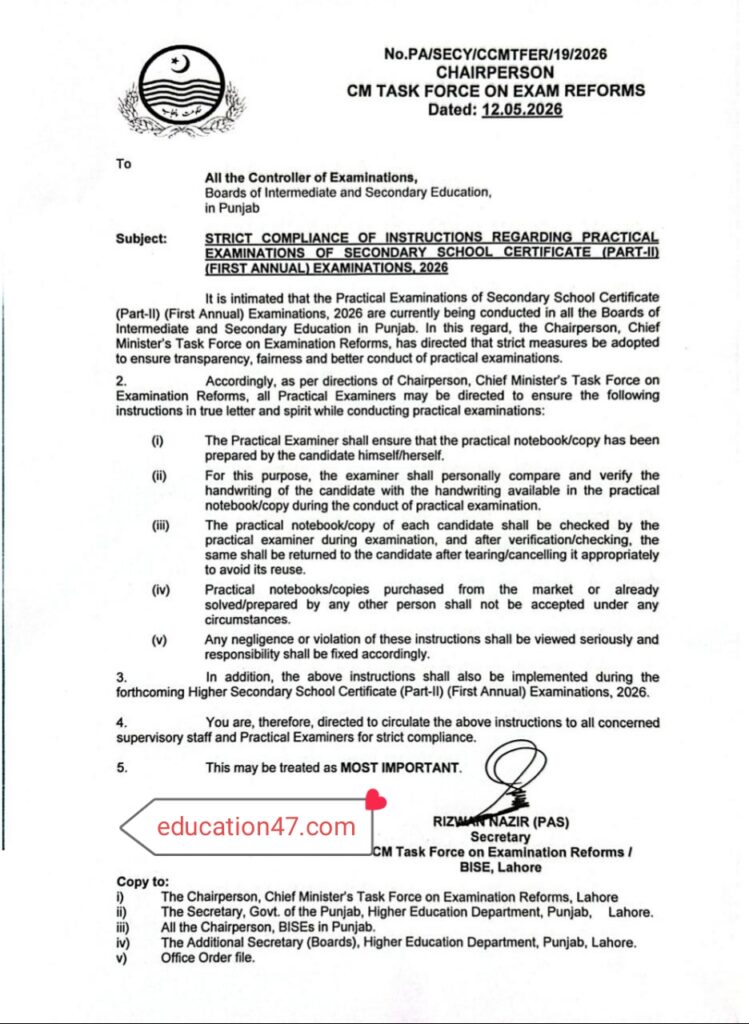
The CM Task Force on Examination Reforms in Punjab has issued a formal directive (No.PA/SECY/CCMTFER/19/2026, dated May 12, 2026) to all Controllers of Examinations across all Boards of Intermediate and Secondary Education in Punjab.
The subject of the letter? Strict compliance of instructions regarding Practical Examinations of Secondary School Certificate (Part-II) — First Annual Examinations, 2026.
In simple terms: the Punjab government is cracking down hard on how practical exams are being conducted. And if you’re a student sitting these exams right now, or a parent, or a teacher supervising them — this affects you directly.
This directive applies to every single BISE in Punjab, including:
- BISE Lahore
- BISE Rawalpindi
- BISE Gujranwala
- BISE Faisalabad
- BISE Multan
- BISE Sahiwal
- BISE Sargodha
- BISE DG Khan
- BISE Bahawalpur
No board is exempt. No student is exempt. That’s the point.
Why Did It Come to This?
Let’s be real. Anyone who has been through the Pakistani matric system knows that the “practical notebook” culture has been broken for years. Walk into any stationery shop near a school in Lahore, Faisalabad, Multan, or anywhere else in Punjab, and you’d find ready-made practical copies — neatly filled, perfectly drawn, sold for a few hundred rupees.
Students bought them. Teachers often looked the other way. Examiners checked them off without much scrutiny. It became a system within a system.
The problem? These pre-filled notebooks completely defeated the purpose of practical education. A student who never once properly conducted a chemistry titration or dissected a specimen could still walk out with full practical marks. That’s not an education — that’s a transaction.
Here’s what that broken cycle looked like in reality:
- Student buys a ready-made notebook for Rs. 200–500 from a local shop
- Notebook arrives perfectly filled with diagrams, readings, and conclusions
- Examiner glances at it, ticks it off, moves on
- Student passes with full practical marks — having learned absolutely nothing
- Next year, the same notebooks reappear at the same shops
And evidently, the Chief Minister’s Task Force has had enough of it.
What the New Instructions Actually Say (In Plain Language)
The official directive has five key instructions for Practical Examiners. Let me break them down in a simple table first, then explain each one:
| # | Instruction | What It Means for Students |
|---|---|---|
| i | Notebook must be prepared by the candidate | No bought or borrowed copies |
| ii | Handwriting must be verified on the spot | Examiner compares your writing live |
| iii | Notebook cancelled after checking | Can’t be reused or passed along |
| iv | Market-purchased copies not accepted under any circumstances | Absolute rule, no exceptions |
| v | Violations treated seriously, responsibility fixed | Examiners and students both accountable |
Now let’s unpack each one properly:
1. The notebook must be prepared by the student themselves.
The examiner is now required to confirm — not just assume — that the practical notebook or copy was prepared by the candidate. Not their older sibling. Not a tutor. Not a shopkeeper.
2. Handwriting verification is now mandatory.
This is the one that caught my cousin off guard. The examiner will personally compare the handwriting in the practical notebook with the student’s actual handwriting during the exam. If they don’t match, the notebook gets rejected. Full stop.
This is genuinely smart if implemented correctly. It’s low-tech, immediate, and hard to fake on the spot.
3. The notebook gets cancelled after checking.
Once the examiner has verified and checked the notebook, it will be returned to the student — but only after being torn or cancelled in a way that prevents reuse. So that same notebook can’t be passed along to someone else next year, or reused in another board’s exam.
4. Market-purchased or outsider-prepared notebooks will not be accepted under any circumstances.
Not “in most cases.” Not “usually.” Under any circumstances. That’s the language the directive uses, and it’s deliberately absolute.
5. Negligence or violations will be dealt with seriously.
This one is aimed at the examiners themselves. If an examiner is found to have been lenient, turned a blind eye, or accepted an obviously fake notebook — responsibility will be fixed. That’s bureaucratic language for “someone will face consequences.”
What This Means If You’re a Student Right Now
If you’re currently scheduled for practical exams under any BISE in Punjab, here’s your immediate action checklist. Go through this tonight — seriously:
- ✅ Check every page of your notebook — Is the handwriting consistently yours throughout?
- ✅ Know your content — Can you explain what’s written on any random page if asked?
- ✅ Don’t borrow a “passed” notebook — They’re being cancelled after use now
- ✅ Write naturally during the exam — Don’t try to disguise or alter your handwriting
- ✅ Talk to your teacher today — If there are issues, sort them before exam day, not during
- ✅ Carry your admit card and all required materials — Don’t give examiners any extra reason to scrutinize you
- ✅ Arrive early — The verification process takes extra time this year at many centers
The single biggest mistake is assuming “it’ll be fine on the day.” That assumption has already caused problems at multiple centers this season.
What This Means If You’re a Teacher or Supervisor
The directive explicitly says these instructions apply to “supervisory staff and Practical Examiners.” So if you’re involved in conducting these exams, here’s what you need to keep in mind:
- The pressure is real and personal. Examiners who previously allowed questionable notebooks through are now personally on the hook. The directive doesn’t just say “reject bad notebooks” — it says violations will be viewed seriously and responsibility fixed accordingly.
- Document everything. If you reject a notebook, note it down with the student’s roll number, reason, and time. If a student or parent disputes your decision later, you want that paper trail.
- Be consistent across all students. Applying these rules to some students and not others — for whatever reason — is the fastest way to create a bigger problem for yourself and your institution.
- Communicate clearly to students before they sit down. A 2-minute verbal explanation of what you’re about to check reduces panic and speeds up the process for everyone.
The Bigger Picture: Will It Actually Work?
This is where I get a bit more skeptical, and I think it’s worth being honest about.
Pakistan’s examination reform history is full of well-intentioned circulars that quietly disappeared by the time the next exam season rolled around. The question isn’t whether these instructions are good (they are), but whether the enforcement infrastructure actually exists to back them up.
A few things give me cautious optimism this time:
- The directive comes from the CM Task Force directly — not just from BISE administration. That’s a higher level of political ownership than usual, which means there’s at least some motivation to see it through.
- The handwriting verification method is field-implementable without technology. An examiner can do it in two minutes with their eyes. Simple solutions often stick better than complicated ones.
- The instruction will be extended to HSSC (Part-II) First Annual Examinations 2026 as well — so this isn’t being treated as a one-off experiment.
- The letter is signed by Rizwan Nazir (PAS), Secretary, CM Task Force on Examination Reforms / BISE Lahore — a named, accountable official. That matters.
That said — the real test will be whether violating examiners are actually held accountable, whether rejected students get a fair process, and whether this conversation continues after the exam season ends.
Common Mistakes Students Are Making Right Now
Based on conversations I’ve had and things circulating in student groups online and offline — here are the mistakes I keep seeing:
- Assuming the old system still works. It doesn’t. At least not safely. The risk this year is genuinely higher than it’s been in recent memory.
- Panicking and rewriting everything last minute. If your notebook has some inconsistencies, a calm conversation with your teacher is better than frantically rewriting 40 pages overnight. The latter looks more suspicious, not less.
- Not knowing their own notebook well enough. Even if someone helped you, you need to know what’s in it. Examiners can ask questions about the content. Looking confused about your own practical work raises red flags immediately.
- Trusting rumors over official information. “My cousin said they’re not actually checking” — ignore this completely. The directive is official, dated, and has been sent to every board. Act on official information only.
- Leaving it to the last day. If you have a problem with your notebook, day-before-exam is already too late. Tonight is not too late. Tomorrow morning might still not be too late. The day of the exam definitely is.
FAQs: Real Questions Students Are Actually Asking
Q: What happens if my notebook is rejected at the center?
A: You won’t be able to sit the practical exam that day. You’ll likely need to follow your BISE’s process for re-examination or appeal. The specifics vary by board, so contact your school administration immediately if this happens — don’t wait.
Q: My handwriting has changed since I wrote the notebook months ago. Will that be a problem?
A: Probably not, as long as it’s still clearly the same person’s writing. Natural variation is normal. What examiners are looking for is a dramatically different style — like clearly printed vs. cursive, or adult handwriting vs. a child’s. If you’re genuinely worried, bring it up with your examiner calmly before they start checking.
Q: My teacher helped me fill in some diagrams and labels. Is that okay?
A: Honestly, it depends on how much and how obvious it is. Labels and diagrams drawn by a teacher in a clearly different hand could flag during verification. Talk to your teacher now — before your exam date — and figure out what, if anything, needs to be addressed.
Q: Does this rule apply to all subjects with practicals?
A: Yes. The directive covers all practical examinations under SSC Part-II (Matric) and will also apply to HSSC Part-II (Intermediate). That means Biology, Chemistry, Physics, Computer Science, Home Economics — any subject with a practical component.
Q: What if I genuinely can’t write well due to a disability or medical issue?
A: This is a legitimate concern and boards do have accommodation procedures. Contact your BISE’s controller of examinations office as soon as possible with documentation. Don’t leave this to exam day.
Q: Can I complain if I think the examiner rejected my notebook unfairly?
A: Yes. Every BISE has a complaint/grievance mechanism. Document everything — take note of the examiner’s name, time, and exactly what was said. Your school’s administration can also escalate on your behalf.
Q: Will this affect the marking? Can I still get full marks?
A: If your notebook passes verification, the marking process continues as normal. The verification is a gate — pass it, and you’re treated like any other student. The aim isn’t to reduce marks, it’s to ensure that students who earned those marks actually get them.
Final Thoughts
Look, I get it. The pressure on matric students in Punjab is immense. Families pin enormous hopes on these results. The system has for years offered shortcuts, and students understandably took them when they were available and widely accepted.
But this crackdown — if followed through — is genuinely good for the long run. A generation of students who actually know how to do a titration, who actually understand what they’re observing in a specimen, will be better prepared for college, for university, and for life.
My cousin managed to sit his exam after some frantic last-minute preparation and a very understanding teacher. He said the examiner did check handwriting. It was briefly stressful. And then it was fine — because he knew his content.
That’s the best outcome possible. A few minutes of stress during the exam, relief after — because the work was real.
What Should You Do Right Now?
If you found this article helpful, here’s what I’d suggest:
📌 Bookmark this page and come back if you have more questions as your exam date approaches.
📤 Share this with a student or parent who might not have heard about these new instructions yet — it could save someone from a very stressful morning at the exam center.
💬 Drop your question in the comments below. If you’re facing a specific situation — unusual handwriting, a shared notebook, a subject-specific issue — ask. I read every comment and I’ll do my best to help or point you in the right direction.
📧 Subscribe to the blog if you want to stay updated on BISE news, matric and inter result updates, and education policy changes in Punjab. No spam, just stuff that actually matters.
The exam season is stressful enough without surprises. Stay informed, stay prepared, and good luck. You’ve got this.
Last updated: May 12, 2026 | Source: Official CM Task Force Directive No.PA/SECY/CCMTFER/19/2026
پنجاب بورڈز کے عملی امتحانات 2026 کے لیے نئی ہدایات جاری کی گئی ہیں:
پریکٹیکل فائل/کاپی طالبعلم نے خود تیار کی ہو۔
ایگزامینر ہینڈ رائٹنگ چیک کرے گا۔
مارکیٹ سے خریدی گئی یا کسی اور کی بنائی ہوئی فائل قبول نہیں ہوگی۔
چیکنگ کے بعد فائل/کاپی کینسل بھی کی جا سکتی ہے۔
ہدایات پر عمل نہ کرنے کی صورت میں سخت کارروائی ہوگی۔
یہ اصول SSC اور HSSC کے عملی امتحانات پر لاگو ہوں گے